 Wahat al-Salam - Neve Shalom
 The School for Peace
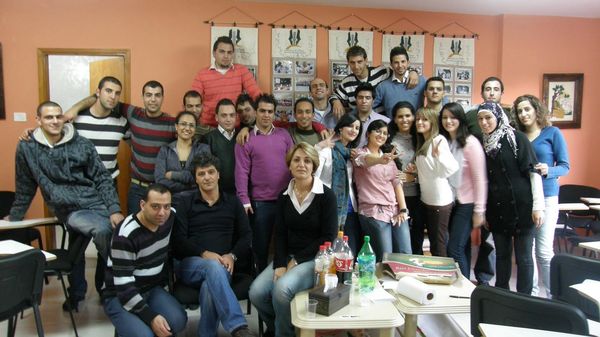
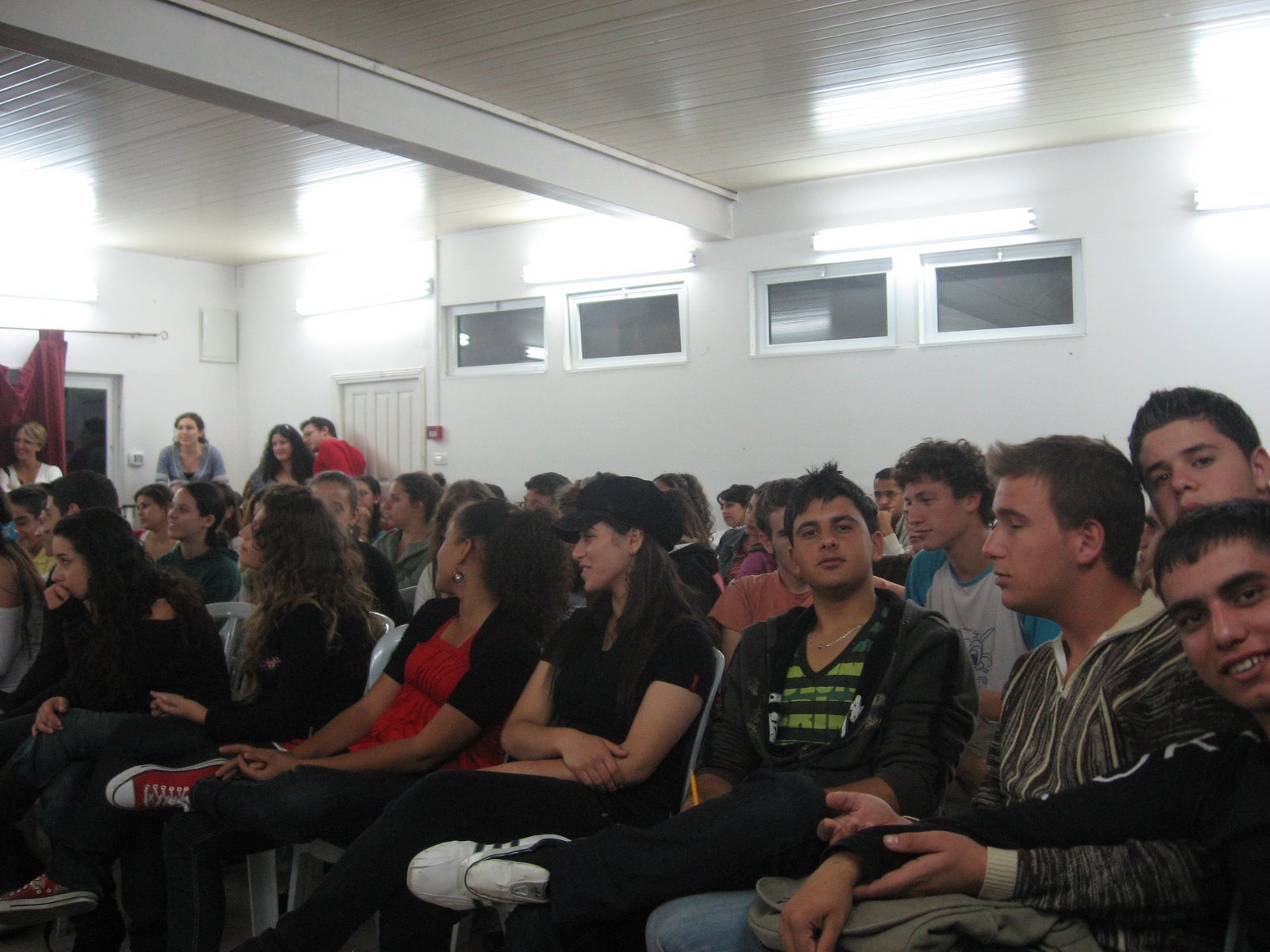
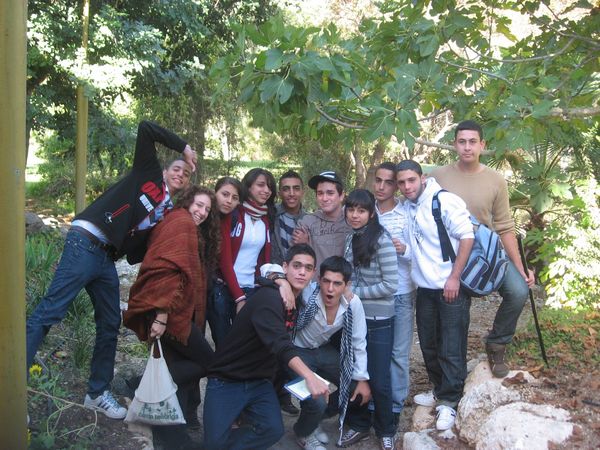
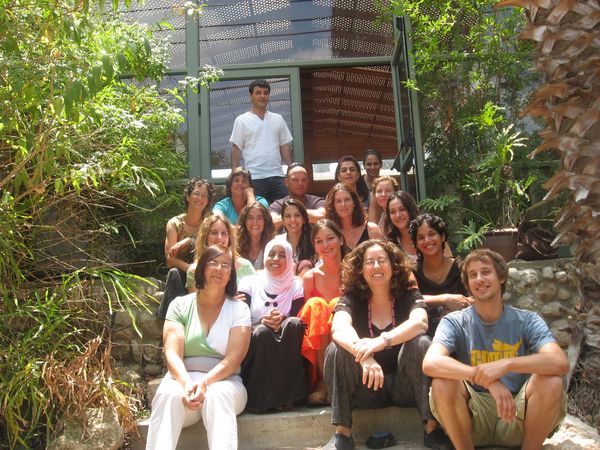
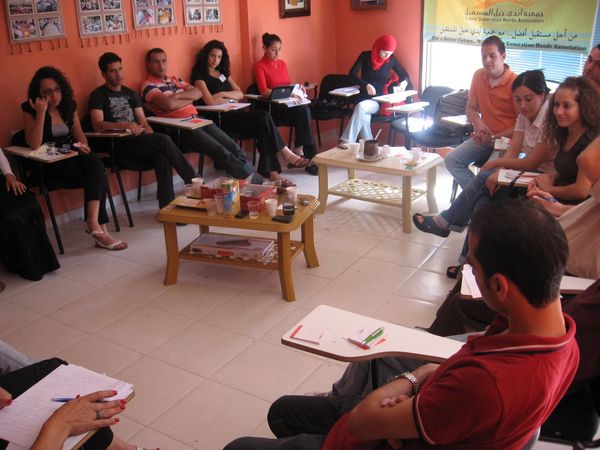
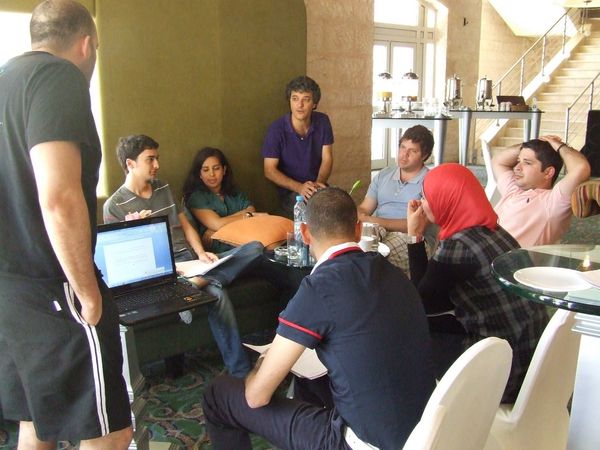
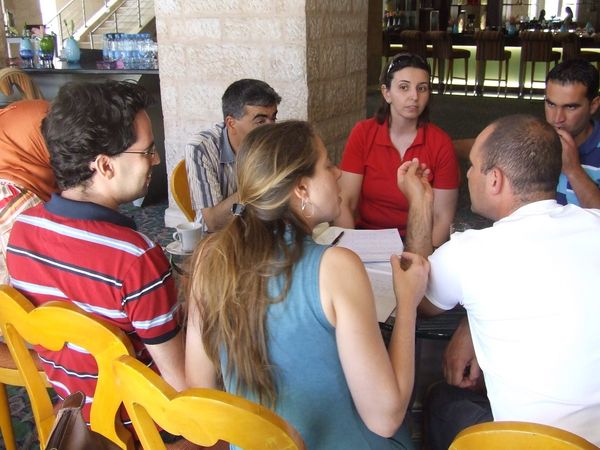

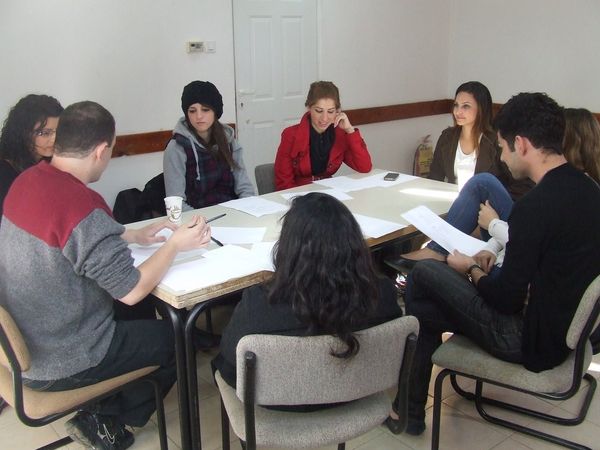
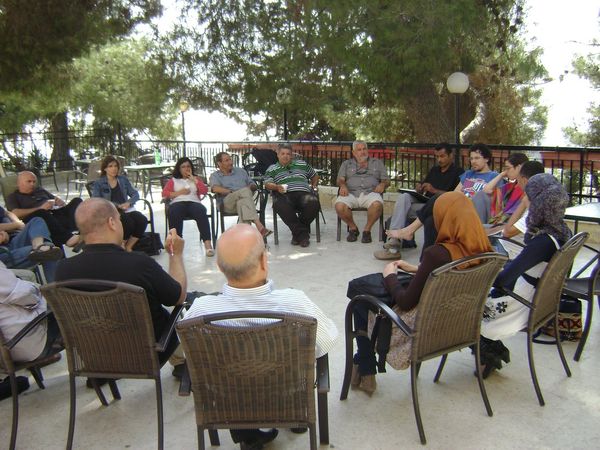
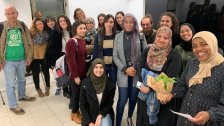
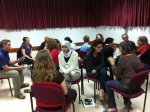
Sixty-one teenagers are taking part in a youth encounter and engaging in a dialogue at the SFP. The workshop is being observed by facilitator trainees.
Home > Oasis of Peace > Projects & Outreach > The School for Peace
The School for Peace is a unique educational institution offering Jewish-Arab encounter programs in the spirit of Neve Shalom/ Wahat al Salam. This work promotes better understanding through broad, in-depth examination of the nature of relations between Arabs and Jews.
See the School for Peace website for more
The School for Peace was established at Neve Shalom/ Wahat al Salam as part of the village’s effort to bring about a more just and egalitarian relationship between Arabs and Jews.
School for Peace brochure (PDF)
The School for Peace (SFP) was created in 1979 as an ideological educational institution of Neve Shalom/ Wahat al Salam. Through encounter workshops and training programs, we try to implement the principles on which the community was founded.
Our goal is to develop participants’ awareness of the conflict and their role in it, and enable them to probe and construct their identity through interaction with the other; our orientation is shaped by the quest for a truly humane, egalitarian and just society.
The School for Peace is an autonomous entity. Funding for its activities comes mainly from foundations and Friends of Neve Shalom/ Wahat al Salam associations abroad, as well as from fees charged to participants. The SFP is run by an executive board and a managerial staff headed alternately, in rotation, by an Arab director and a Jewish director. The professional staff comprises a roughly equal number of Jewish and Arab facilitators, with academic backgrounds in the humanities and social sciences, and special training in facilitating groups in conflict. Every encounter program is run by Arab and Jewish facilitators on an egalitarian basis, and strives to address the needs of each national group, acknowledging natural limitations in the ability of each to understand the other.
Since the School for Peace first opened its doors, some 65,000 Jews and Arabs have attended its programs. Some are conducted at the school’s campus at Neve Shalom/ Wahat al Salam; others take place elsewhere in Israel, Palestine, the region, and beyond.
The SFP offerings are diverse and include uni-national and bi-national programs and activities. They are offered to a variety of groups from different sectors of the society – schoolchildren, teachers, students, social service professionals, activists in social change organizations, attorneys, planners, the general public, and professionals who work in various roles with both the Arab and the Jewish populations.
Our intention is to enable participants to enrich their perspectives, to critically examine things ordinarily taken for granted, and to try to comprehend the turbulent and violent processes taking place all around us. We have found that a unique learning experience can be offered by relating directly to events, in a safe space that permits people to examine their feelings and thoughts in the group setting. Facts and information alone are inadequate to create social awareness and prompt a renewed examination of things as they are: We must pose new possibilities and challenge the existing reality. Our team of facilitators brings a critical approach to current reality and emphasizes the implications of majority-minority relations and the asymmetry in the existing power relationships.
Our work is guided by four basic assumptions:
1…The beliefs and outlooks on which a person’s identity and behavior are constructed are deep-seated and stable, and generally resistant to change. Our work attempts to expose these outlooks and permit people to grapple with them.
2… The conflict rests on an encounter between two national groups, not between individuals; hence we see the group as having an essential importance, beyond the sum of the individuals comprising it.
3… The group is a microcosm of reality and thus offers an avenue for learning about the society at large.
4…The encounter group is an open entity, linked to and influenced by the larger reality outside.
The facilitation staff is trained in an approach that stresses dialogue, based on these four assumptions. Facilitators try to uncover and delve into the pertinent relations in the society and to deconstruct oppressive structures – and this approach, in and of itself, conveys an enriching experience that exposes participants to an alternative discourse.
For information about activities and publications of the School for Peace, please visit the dedicated School for Peace web site.
Portfolio
Articles
-
 Youth Encounter between Givat Brener and Nazareth
30 November 2015 -
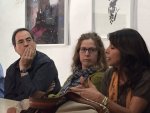 Meeting and Tour in Sakhnin
27 November 2015The School for Peace change agents course for Jewish and Palestinian architects and engineers met November 27 in Sakhnin
-
 School for Peace Newsletter for Summer 2015
3 September 2015The SFP recounts recent successes and looks forward to an exciting new activity year
-
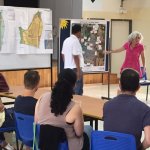 Tour of Jisr az-Zarqa
23 August 2015In the framework of its course for urban planners, architects & civil engineers, the SFP initiated a tour of Jisr az-Zarqa.
-
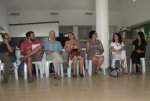 School for Peace End of Year Summary Event
22 August 2015On July 30, 2015, the School for Peace organized an event for the end of its activity year. Some 30 Arab and Jewish facilitators and activists who work with the SFP came, as well as WAS-NS residents.
-
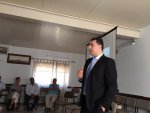 Lecture on legal aspects concerning Arabs in mixed cities
28 July 2015As part of the 2015-2016 training course for change agents in Israeli mixed cities Att. Kais Nasser gave a lecture on legal aspects affecting the Arab population
-
 SFP wins S.E.R. Reconciliation Award
28 July 2015The SFP has been informed by the S.E.R. Foundation (Germany) that the Program for Palestinian and Israeli Literature Teachers has received the S.E.R. Reconciliation Award 2013 – 2014
-
 Int’l conference on Dilemmas of Recognition in Asymmetric Conflicts
22 June 2015On 4-5 May 2015 the SFP, in cooperation with two universities, convened an int’l conference on Dilemmas of Recognition in Asymmetric conflicts: the Israeli-Palestinian Conflict in a Comparative Perspective.
-
 Spring 2015 Newsletter: Latest Activities & Programs
23 April 2015An update that includes reporting on our activities; and introduces our new program director.
-
 Dilemmas of Recognition in Asymmetric Conflicts: The Israeli-Palestinian Conflict in a Comparative Perspective MAY 4-5, 2015
10 April 2015With the Inst. of Advanced Studies of Hebrew Univ. & the Walter Lebach Institute of the Univ. of Tel Aviv, the SFP has organized an int’l conference.
-
 School for Peace 2014 Annual Report
16 March 2015The School for Peace provides a 15-page overview of all of the activities that it conducted during the 2014 calendar year
-
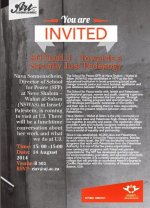 Nava Sonnenschein gives presentation in S. Africa
11 September 2014While in South Africa, Dr. Nava Sonnenschein gave a seminar on the work of the SFP.
-
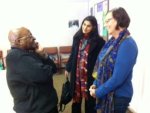 Nava Sonnenschein receives a special blessing from Rev. Desmond Tutu
15 August 2014While in South Africa, SFP director Dr. Nava Sonnenschein had the opportunity to meet with Rev. Desmond Tutu and inform him about the work of the SFP.
-
 News from the School for Peace: February – June 2014
10 July 20143 months of intensive activity
-
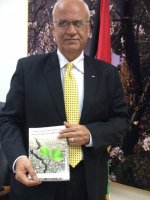 School for Peace book presented to Dr. Saeb Erekat
3 July 2014Dr. Saeb Erekat accepts a copy of the SFPs anthology “Two People Write from Right to Left”
-
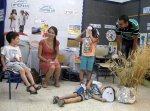 Participants in SFP Course at Ben Gurion U. volunteer at Hagar School
2 July 2014As part of a joint SFP-Ben Gurion Uni course the Jewish & Arab participants are doing volunteer projects.
-
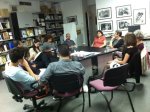 School for Peace forum for Graduates
29 June 2014At the heart of the SFP’s strategy for initiating social change is encouragement of its graduates to conduct action projects
-
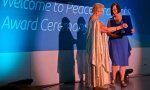 SFP awarded $50 K grant by Journalists and Writers Foundation (Turkey)
4 June 2014The SFP has won a $50,000 grant from [Journalists and Writers Foundation (JWF)] in Turkey, towards a joint project with Ramallah based Tawasul for teaching literature teachers.
-
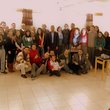 Completion of Change Agents Course for Up-and-Coming Politicians
23 December 2012On Friday December 21, the School for Peace and its Palestinian partner Tawasul concluded a 21-month course for 50 aspiring young politicians and social change leaders in Israel and Palestine.
-
 Two peoples write from right to left: Palestinian and Israeli anthology of poems and short stories
23 January 2012The School for Peace has published an anthology of Hebrew and Arabic literature.


